
2026
SA plans to move alcohol limit to zero to curb drunk driving
An anti-drunk driving group says it supports the plan to amend the law to lower the legal blood alcohol limit to zero.
Transport Minister Barbara Creecy this week announced that while the number of road deaths during the festive season dropped by five percent, drunk driving remains a worrying factor.
More than 8 500 motorists failed breathalyser test during festive season operations, a 144% increase compared to the previous period.
Read the full article here
https://www.ecr.co.za/news/news/sa-plans-move-alcohol-limit-zero-curb-drunk-driving/
Activists back Minister Creecy’s bold ban on drinking and driving
Transport Minister Barbara Creecy’s bold move to ban drinking and driving has sparked widespread support from road safety advocates and labour organisations, who hail it as a long-overdue change in South Africa’s fight against road fatalities.
Read the full article here
https://iol.co.za/news/2026-01-16-activists-back-minister-creecys-bold-ban-on-drinking-and-driving/
Newspaper article: 16.1.2026 Die Burger
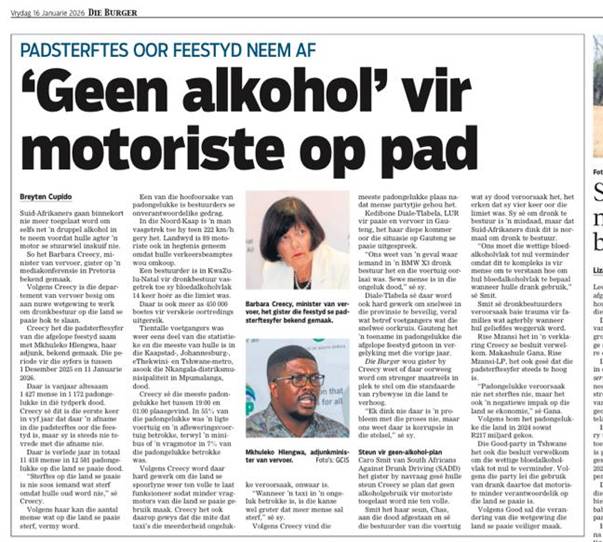
https://www.netwerk24.com/nuus/politiek/padsterftes-in-feestyd-neem-af-0-perk-op-alkohol-kom-creecy-20260115-0926
SADD support the call by Minister Creecy to change the alcohol driving limit to zero
Q: Would possible changes to alcohol-consumption legislation like raising the drinking age and banning drinking before driving could see a drop in the number of alcohol-related crashes we see on our roads”
A: Yes, SADD definitely support these measures and think they will bring down the very preventable crashes we see on our roads, because of the following reasons.
Changing the drinking age to 21 is 1 of the World Health Organizations recommendations about best practices, based on research that shows that moving the drinking age to 21 brings down alcohols’ harm to the youth – this includes alcohol poisoning, damage to the brain, driving under the influence, etc. The brain is only completely developed at about age 25, and before that youth often engage in risky behaviours like having down-down competitions, drinking then driving, speeding, feeling bullet proof, and not understanding the severe consequences of their behaviours on self or others, because the brain is not fully developed. Car crashes in the youth are the leading cause of road deaths in the youth, worldwide, and alcohol is involved in many cases (in SA in about 50% of the cases)
Re: banning drinking before driving.
Changing the BAC to Zero will stop any doubt about how much a person can drink before driving, or if they are safe to drive. Zero means Zero. People don’t seem to understand that if they have had a big party the night before, that they can still be over the legal limit the next day, and a danger to all. They think if they don’t feel “drunk” that they are safe to drive, meanwhile any alcohol affects driving skills. Many people don’t understand what our legal limits are, what that means, how many “drinks” they can have and how long it takes for alcohol to get out of their body. They don’t understand how many units there are in different drinks.So, the only thing that people will understand is Zero. So, it’s very clear cut and non-negotiable.
If you look at the number of people who’ve been killed in the past 20 years, on an average of about 14,000 deaths a year, that’s 280,000 people who have died. Alcohol abuse is behind 50% of those cases. So that’s 140,000 people who were killed and 140,000 traumatized families.
And then if you look at the number who have been injured. It comes to something like 1,120,000 injured people in 20 years. Alcohol abuse accounts for about 560,000 injured people and 560,000 traumatized families.
So, we really need to get these deaths down, and bringing the alcohol limit to zero will help that.
As Barbara Creecy said “These deaths are a reason for national shame.”
SADD agree that a ‘Zero-Tolerance’ policy, is probably the only effective way to curb South Africa’s persistently high road fatality rate.”